
Assoc. Prof. Dimiter Prodanov, Dr. MEng. Hristo Hristov, Assoc. Prof. Zlatogor Minchev, Assoc. Prof. Mitko Shoshev, PhD Candidate Irina Kancheva ,Assist. Veneta Koleva, Assist. Teodor Vakarelsky and Dr. Kalin Dimitrov are the authors of a new study exploring how non-invasive brain–computer interface (BCI) technology can be used to monitor cognitive workload through physiological signals.
The study, titled “Sensing Cognitive Responses Through a Non-Invasive Brain–Computer Interface”, combines electroencephalography (EEG) with measurements of heart rate, skin conductance, facial temperature and blood oxygen saturation. The researchers examined how these indicators change during rest and cognitive tasks involving attention and mental arithmetic.
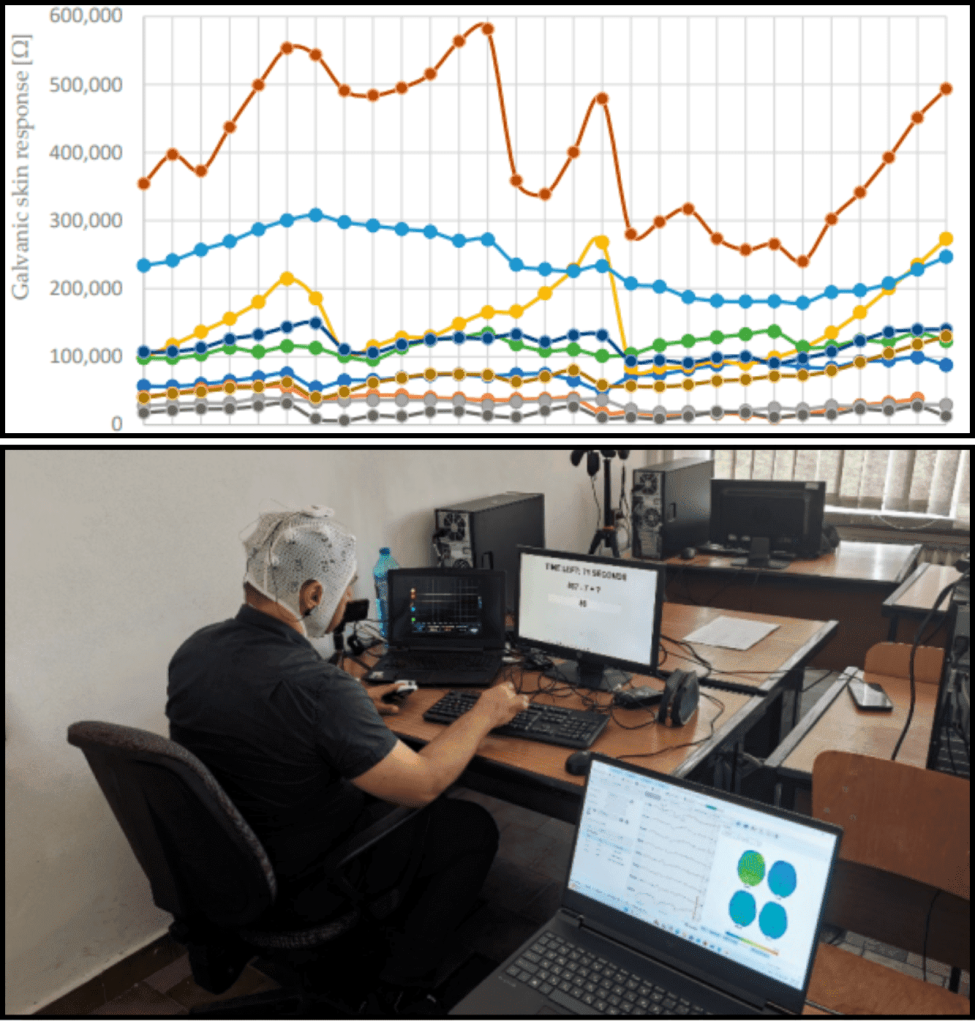
The findings highlight heart rate as an indicator of changes associated with cognitive workload, while EEG measurements provide additional insights into brain activity during mental tasks. The study also emphasizes the importance of individual physiological differences and the need for further research involving larger groups of participants.
Published in Sensors in March 2026, the research was partially supported by the European Union’s Horizon Europe programme through the VIBraTE project.